If you are going to walk the floor in Barcelona next week, you will see some breathtaking engineering. You will also see a striking number of concepts that still have to prove they can make money at scale
I say this not out of cynicism, but from hard-won realism. There remains a profound disconnect between the dazzling vendor demos at Mobile World Congress and the balance sheets waiting on CTO and CFO desks back home.
Mature markets in the US and Europe face a sobering truth. While some emerging-market operators are growing strongly, ARPU here is functionally flat and Return on Invested Capital continues its steady decline under the weight of hundreds of billions in infrastructure debt. The age of deploying technology for technology’s sake is over. The new mandate is ruthless in profitability. If a solution cannot be directly linked to measurable margin improvement, it is not an investment — it is a liability.
As we cut through the noise, four dominant narratives demand aggressive scrutiny.
1. The Physical AI Reality Check: Intent Does Not Equal Deployment
The loudest story on the ground is “Physical AI” — the promise that telecom networks will become the digital nervous system of the economy. NVIDIA’s freshly released 2026 State of AI in Telecommunications survey fuels the excitement: 90% of respondents claim AI is already lifting revenue and cutting costs.
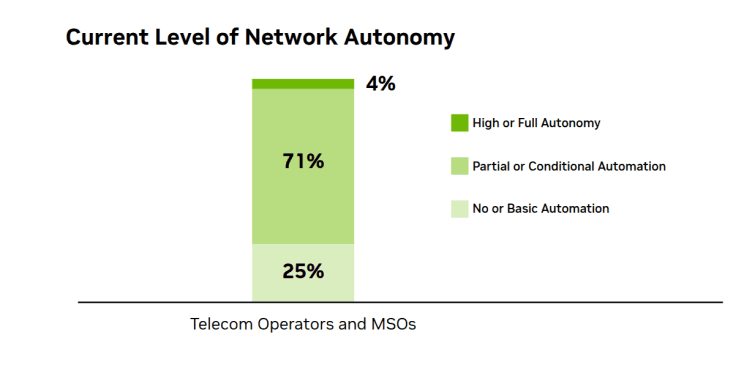
Yet any operator wrestling with tight P&Ls must ask: is this operational reality or carefully curated optimism? Many of those respondents are vendors whose business models depend on the hype. Surveys capture sentiment; balance sheets reveal execution.
At TelcoBrain, our work tells a different story. The smartest capital is not chasing generic autonomous networks. It is flowing into structured data models, graph-based dependency mapping, and sovereign AI governance — the true foundations. We are building an advanced nervous system without first installing the economic brain. We risk a future in which a drone makes a split-second inference at your cell site while your legacy BSS has no idea how to price, bill, or settle that transaction in real time.
2. The NTN and Orbital Reality Check: Physics Meets the P&L
Direct-to-Device NTN and orbital edge compute dominate the keynotes. Connecting an unmodified smartphone to a LEO satellite is a genuine RF engineering triumph, but the physics is unforgiving.
LEO satellites scream past at enormous relative velocity, generating severe Doppler shifts. Even if the radio layer succeeds, legacy billing systems frequently cannot reconcile hybrid roaming CDRs in real time. What looks like a premium SLA quickly becomes an operational blind spot and a quiet revenue leak.
We are not suggesting this technology will never succeed. Several visionary tech leaders like StarLink and few CSPs are building or co-owning constellations to extend their footprint into space. That ambition is transformative for those with the right capital structure. However, for most traditional operators, space compute should not displace near-term priorities around terrestrial 5G monetization and taping into AI use-cases.
Orbital data centers promise “free” cooling, yet in vacuum heat leaves only by radiation — about a square meter of radiator per 700 W GPU. The SpaceX thesis is that cheap launch will eventually make orbital compute inevitable. Perhaps. But routing enterprise workloads to orbit before terrestrial edge economics work is physics denial dressed as strategy.
3. The Unsexy Truth: AI’s Symmetrical Fiber Imperative
While cameras chase satellites, serious capital is going into the ground. Hyperscale AI is flipping traffic patterns from downstream-heavy streaming to persistent, symmetrical edge-to-cloud flows.
Telcos are being asked to fund a massive optical fiber and DCI build-out. Laying more glass to carry hyperscaler traffic is seductive — until you realize you are volunteering to become their "dumb optical pipe." Real value capture demands dynamic, margin-aware pricing for ultra-low-latency routes. If your infrastructure cannot calculate the exact profit margin of a specific wavelength in real time, you are simply subsidizing someone else’s AI revolution.
4. The Open Gateway API Wall
Open Gateway has delivered welcome traction in basic services like SIM swap. However, the grand vision of developers buying dynamic slices or Quality-on-Demand has hit a structural wall.
The bottleneck is not the network — it is fragmented legacy systems. You cannot expose advanced capabilities if billing still takes days. An automated action that cannot be instantly priced, billed, and margin-checked is orchestration theatre, not monetization.
Master the 5G-Advanced Foundation: The Real Path to 6G
There is a lot of talk this week about 6G, but we must not repeat the cycle of chasing the next generation before we have mastered the economics of the current one. The winners of the next decade will be those who use the 5G-Advanced (Release 18/19) era to fix the industry's structural ROI problems.
5G-Advanced is our laboratory. It is where we prove RedCap for mass-market IoT, test uplink-heavy configurations for AI, and deploy AI-native radio optimizations. If we cannot monetize a 5G-Advanced slice or prove the unit economics of an AI-driven handover today, 6G will simply be a more expensive version of the same frustration.
Beyond Legacy ERP: The Unified Techno-Economic Core
For decades we have operated behind an invisible wall: OSS teams manage physics, BSS teams manage money. Monolithic ERP systems — built for the linear world of the last century — cannot bridge that gap in a millisecond-driven AI reality.
At TelcoBrain, we are driving Techno-Economic Convergence. We advocate for a Unified Techno-Economic Core — a cognitive overlay that translates meaning between existing systems in real time. A network fault instantly becomes a revenue risk. Energy consumption becomes a direct profitability lever. It replaces the manual “grayware” holding operators together with autonomous economic intelligence.
Your MWC 2026 Executive Playbook (Action Plan)
Give your procurement and engineering teams this clear mandate:
Demand AI Unit Economics: Stop funding generic autonomous-network POCs. Require vendors to show verifiable OPEX savings against real AI operating costs.
Secure Billing Before the Beam: Do not commit heavy CAPEX to D2D or orbital initiatives until your BSS can settle hybrid sessions in real time.
Stop Subsidizing Hyperscalers: Implement dynamic, margin-aware pricing for symmetrical AI traffic or accept you are just building someone else’s pipes.
Sell SLAs, Not Slices: Abstract the network for developers. Deliver guaranteed cloud-native outcomes and know exactly what each SLA actually costs you.
The Techno-Economic Test
As you walk the Fira Gran Via, apply one ruthless filter to every demo:
“When this autonomous action occurs or technology implemented, how does it instantly communicate with my legacy billing and inventory systems to prove — in real time — that it improved my profit margin/ROIC?”
If the vendor cannot answer clearly selling you hype trapped in yesterday's economics.
When the show closes and you return to your actual budgets, the real work begins. The future belongs to operators who master both engineering excellence and economic execution.